
This rather cryptic poem written by Ülkü Tamer (1937-2018) titled Konuşma (1959) has been analysed a couple of times by literary critics. Some interpretations have understood the Black figure in the poem as representing racial and social marginalisation of the African-American community: someone held back by society and ultimately deprived of the means to escape his circumstances. Before presenting my own interpretation, I would like to include my summaries of two existing readings of the poem, both of which I find quite valuable in understanding the meanings behind this poem. The first is Fatih Öztürk’s (2025) analysis based on critical pedagogy, published in the Hacettepe University Journal of Faculty of Letters, and the second is an essay by Canan Aktaş published in Karnaval Dergi.
Some literary context about the poem
Tamer is considered one of the representatives of the İkinci Yeni (Second New) movement in Turkish literature. Poems associated with this movement often feature surrealist elements and depart from the conventions of traditional poetry. This poem exemplifies these characteristics by presenting a very real observation through a surrealist lens.
I must also admit that translating a poem with such a grim subject matter and sensitive themes, combined with a highly unconventional writing style, has been quite challenging for me. I went back and forth several times, having initially begun my translation and analysis in August. This means it took me approximately two months to arrive at a version that I find satisfactory.
About the term zenci
The Turkish term zenci is also a subject of debate. Some argue that the word has undergone a semantic shift and acquired derogatory connotations, others maintain that it is not inherently pejorative and suitable for daily usage. Frankly, I would not touch that debate with a ten-foot pole, and I leave the question open to the Afro-Turkish community and my Turkish-speaking readers.
For the purposes of this translation, I have chosen to render the term as “Black man.” I believe this reflects the originally intended meaning in the poem and preserves the dignity of the person being described better than the alternatives.
It is also worth noting that siyahi, generally regarded as a more neutral alternative (which is also thought to be more racially insensitive by some), is a relatively recent addition to common Turkish usage, and it was most likely not a matter of choice between the two words for Tamer. My personal impression is that zenci was the conventional term for a Black person at the time this poem was written and was not necessarily used with pejorative intent. I believe this historical context is important when considering the language of the original poem.
For further discussion of this debate in the context of media usage, you may refer to Öztin’s (2021) article, listed in the references.
As always, I’d love to hear your thoughts about my translation and analysis as well!
Öztürk, 2025
Öztürk reads Konuşma through the framework of critical pedagogy. For him, the “Black” student represents an excluded, alienated and disadvantaged individual who does not conform to the standards imposed by the dominant social and educational system. The student’s ethnicity, weight, family background and academic failure all become labels by which he is judged rather than parts of an individual life. In this reading, the poem criticises an educational system that attempts to produce a single acceptable type of student and consequently alienates those who fall outside its expectations.
Öztürk therefore interprets the student’s suicide not simply as an individual decision, but as the tragic conclusion of this process of alienation. In his words, the student does not really choose this end but rather resigns himself to it: he gradually loses hope for the future, becomes alienated first from society and then from himself, and finally allows his identity to be defined by an external, imposed gaze. For Öztürk, the poem ultimately echoes critical pedagogy’s demand that students be treated as autonomous individuals rather than objects to be moulded by the status quo.
Öztürk also pays particular attention to the apparent contradiction in the final line. The student is associated with oppression and lost freedom, while the bird represents innocence, nature and freedom; yet the speaker, immediately after contemplating the student’s death, proposes shooting a bird simply because he is bored. Öztürk sees this contradiction as an ironic tension that exposes both the human capacity for violence and the confinement of the modern individual.
Aktaş
Aktaş offers a somewhat broader social reading. She emphasises the characteristic contrast in Tamer’s poetry between humour and suffering: the poem sounds almost cheerful and absurd on the surface while dealing with suicide, loneliness, exclusion and social tragedy underneath. In her interpretation, both Blackness and obesity function as markers of being visibly different and socially marginalised, allowing the poem to speak about forms of exclusion that extend beyond any single society or group.
With a connection with Frantz Fanon, Aktaş treats the Black figure particularly as an image of identity under assimilation and social oppression. She argues that the specific identity could be substituted with various marginalised ethnic or social identities in Türkiye: what matters is the experience of remaining an outsider even after attempting to change one’s class or social position. She similarly reads the student’s failure to “know his lesson” and his being “good at divorce” as signs of an inability to adapt to the social order. For Aktaş, the humour and apparent nonsense of the poem therefore conceal a much deeper confrontation with class, identity, alienation and the ways in which society excludes those who do not fit into it.
My interpretation
My own interpretation is a bit different, which is also why I decided to translate the title as Monologue rather than Dialogue. It makes me think of all the times I have tried to solve someone else’s problems or try and fix a social issue in my head through an internal monologue, especially when I am terribly bored.
To me, it seems like the inner monologue exemplifies and mocks the white status quo’s point of view to a tragedy, which still antagonises the Black man after his death as if to blame him for it, while disregarding the wider sociological issues faced by that group.
The line “babası değirmenci” [his dad, a miller] also seems to emphasise that he was the first generation from his family to get formal education, which he -on a surface level- fails miserably, and actually is failed by the system itself.
“Sizden iyi olmasın, boşanmada birinci” [No better than yourself, of course—at divorce he topped the game] is a particularly powerful line in delivering the idea of a man who is good at only seemingly bad acts that the society finds reprehensible.
I like to think that, on a more meta level, the central idea of the poem is empathy. Empathy to someone the author does not know, an empathy he presents through a satirical lens. I cannot help but find parallels, and perhaps some degree of intertextuality, between Tamer’s monologue and Bedri Rahmi Eyüpoğlu’s Üç Dil [Three Languages], especially its final line: “Oğlum Mernuş, sen otobüsü kaçırmış bir milletin çocuğusun” [My son, Mernuş, you are a child of a nation that missed the bus].
I leave it to literary scholars to determine whether there is any actual historical connection between the two poems; nevertheless, I believe the parallel is there. To me, Eyüpoğlu’s line is an outward expression of empathy and criticism of his own nation, whereas Tamer’s poem feels like an internal act of problem-solving: the speaker constructs an entire life for someone else, tries to make sense of his problems and his death, wanders from one thought to another, and then, almost absurdly, becomes bored and moves on. The final act of shooting birds is in line with the seemingly good-for-nothing acts the status quo criticises about the said community, and the poet joins in the act in the end.
Konuşma, Ülkü Tamer
Aman, kendini asmış yüz kiloluk bir zenci,
Üstelik gece inmiş, ses gelmiyor kümesten;
Ben olsam utanırım, bu ne biçim öğrenci?
Hem dersini bilmiyor, hem de şişman herkesten.
İyi nişan alırdı kendini asan zenci,
Bira içmez ağlardı, babası değirmenci,
Sizden iyi olmasın, boşanmada birinci.
Çok canım sıkılıyor, kuş vuralım istersen.
Monologue, Ülkü Tamer
Good grief, a hundred-kilo Black man hanged himself, you see;
night has fallen, the henhouse is quiet, not a sound to hear.
If I were him, I’d blush for shame—what kind of pupil can he be?
He doesn’t know his lessons, and he’s fatter than his peers.
The Black man who hanged himself had perfect aim, you see;
he never drank beer, he cried; his father, a miller.
No better than yourself, of course—at divorce he topped the game.
I’m terribly bored. Shall we go and shoot some birds?
References
Aktaş, C. (n.d.). Ülkü Tamer’in “Konuşma” şiiri üstüne. Karnaval Dergi. https://karnavaldergi.com/blog/ulku-tamerin-konusma-siiri-ustune/
Öztin, K. (2021). AFRO-AMERİKAN TOPLUMUNUN ADLANDIRILMA BİÇİMLERİNİN TÜRKÇEYE AKTARIMINA İLİŞKİN BİR İNCELEME. Dil Dergisi, 172(1), 43-59. https://doi.org/10.33690/dilder.778893
Öztürk, F. (2025). Eleştirel Pedagoji ve Ülkü Tamer’in ‘Konuşma’ Şiiri. Hacettepe Üniversitesi Edebiyat Fakültesi Dergisi, 42(2), 533-546. https://doi.org/10.32600/huefd.1628352
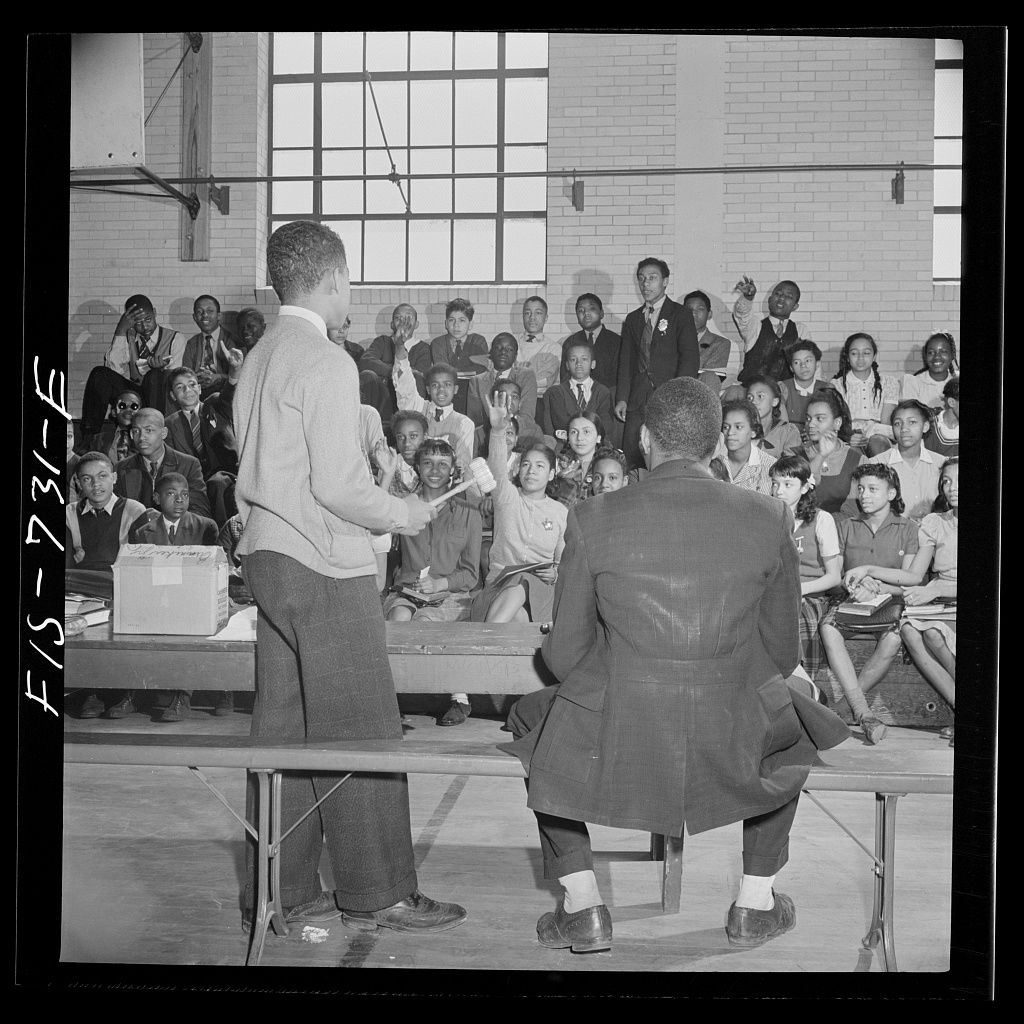
Thumbnail: Collins, M. (1942). Washington, D.C. Student council meeting at the Banneker Junior High School [graphic]
Washington, D.C. Student council meeting at the Banneker Junior High School https://lccn.loc.gov/2017829291
(No known restrictions. For information, see U.S. Farm Security Administration/Office of War Information Black & White Photographs https://www.loc.gov/rr/print/res/071_fsab.html)
Leave a Reply